Editorial notes
buywith at a glance
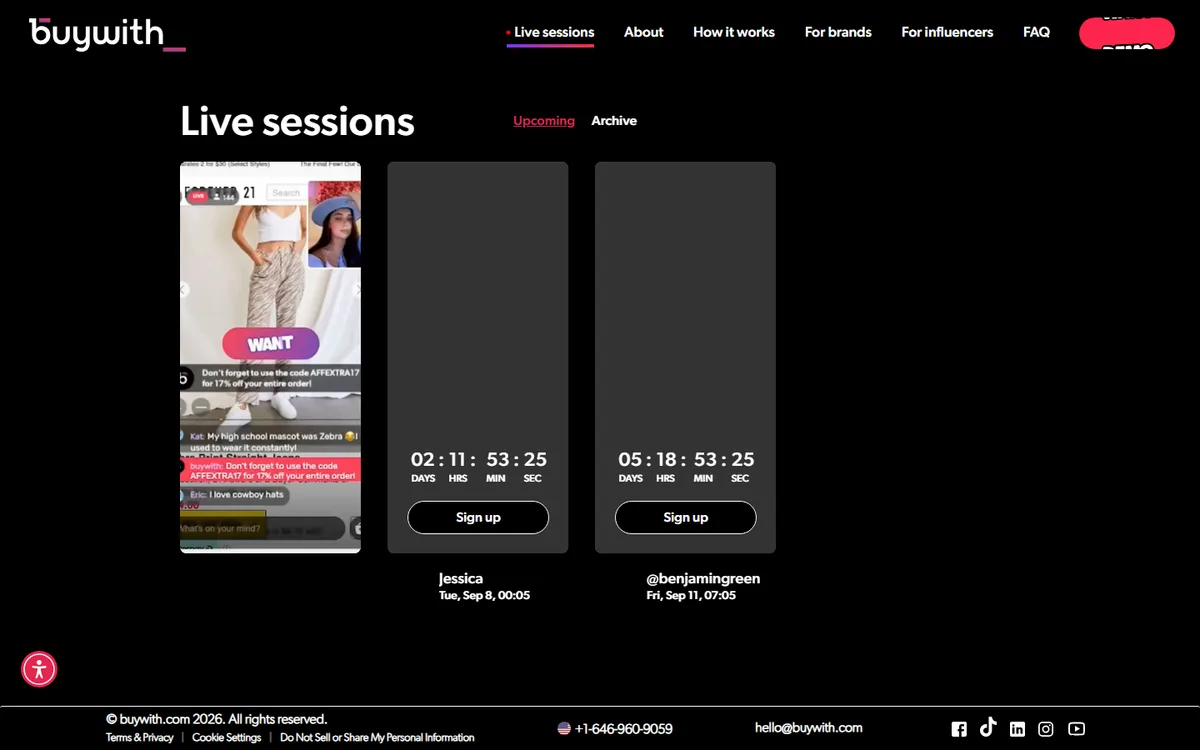
buywith is built around host-led shopping sessions rather than a passive video gallery. Its product material describes one-to-many live events where an influencer takes viewers through a brand site, and one-to-one sessions where a shopper and expert co-browse, schedule an appointment, and complete a purchase without leaving the session. The platform therefore has a clear live-commerce role: people watch or participate in a live shopping interaction while products and a purchase path are available.
This model suits brands that want a social-shopping event on an owned site or a personal shopping appointment. A one-to-many event has different staffing and moderation needs from a one-to-one consultation. For either path, the brand still provides accurate catalog data, stock state, commercial policies, a trained host, and recovery for a failed browser or payment handoff. In-session checkout signals the intended journey, not proof that buywith is merchant of record.
The AI function, stated narrowly
buywith’s Snippets page documents a focused AI feature: advanced AI automatically creates bite-sized snippets from a longer live-shopping recording, selecting products shown during the event and producing versions with captions and highlights. The company describes using those shoppable snippets on product pages, social media, and paid campaigns. Its API article also refers to AI-generated snippets from live-shopping events.
The correct classification is AI-assisted repurposing after a live event. It does not establish an AI avatar, autonomous presenter, real-time chat agent, or AI decision-making during checkout. Public pages do not state a processing SLA, guaranteed snippet count, accuracy threshold, language coverage, or a public moderation workflow. Merchants must review clips and captions before using them as ads or persistent product content, because a product, price, or claim visible in an event may no longer be valid.
APIs, pricing, and delivery model
buywith says its API suite can programmatically create events, retrieve statistics, support product-video integration, and surface live-shopping metrics. It says the product can be embedded with a line of code and references documentation and support. This establishes an API or integration route, although it is not a substitute for reviewing endpoint scope, authentication, webhooks, limits, and regional data handling during implementation.
The current official product pages are demo-led. No official public subscription price, reliable free tier, or trial duration was located in the reviewed material, so this profile uses unknown for free access rather than repeating an old promotion. Terms pages discuss influencer commissions assigned by brands; they are not a SaaS price list. Obtain an offer covering event volume, viewers, host services, integration work, and any AI-snippet allowance.
The delivery surface is web-based live shopping, with a brand or creator host and optional shared browsing. Rehearse join links, scheduling, creator permissions, product deep links, and checkout return paths. Agree who answers questions, who handles registration data, and how the event is archived. Then test a recording through the snippet workflow and have merchandising approve reusable assets.
Choose buywith when the human-led shop-with-me dynamic, creator marketplace, or video consultation is central. Firework and Bambuser offer broader enterprise stacks; CommentSold pairs live retail with boutique operations; Videowise provides a modular live-shopping and AI-library alternative. buywith qualifies here because official material supports AI clip extraction from live events, not because every session is synthetic.
For creator-led broadcasts, confirm contractual approval for screen sharing, recording, clip reuse, audience messages, and performance data. Those responsibilities sit outside the automated extraction claim and deserve an explicit event runbook.
 AI Live Video