 AI Live Video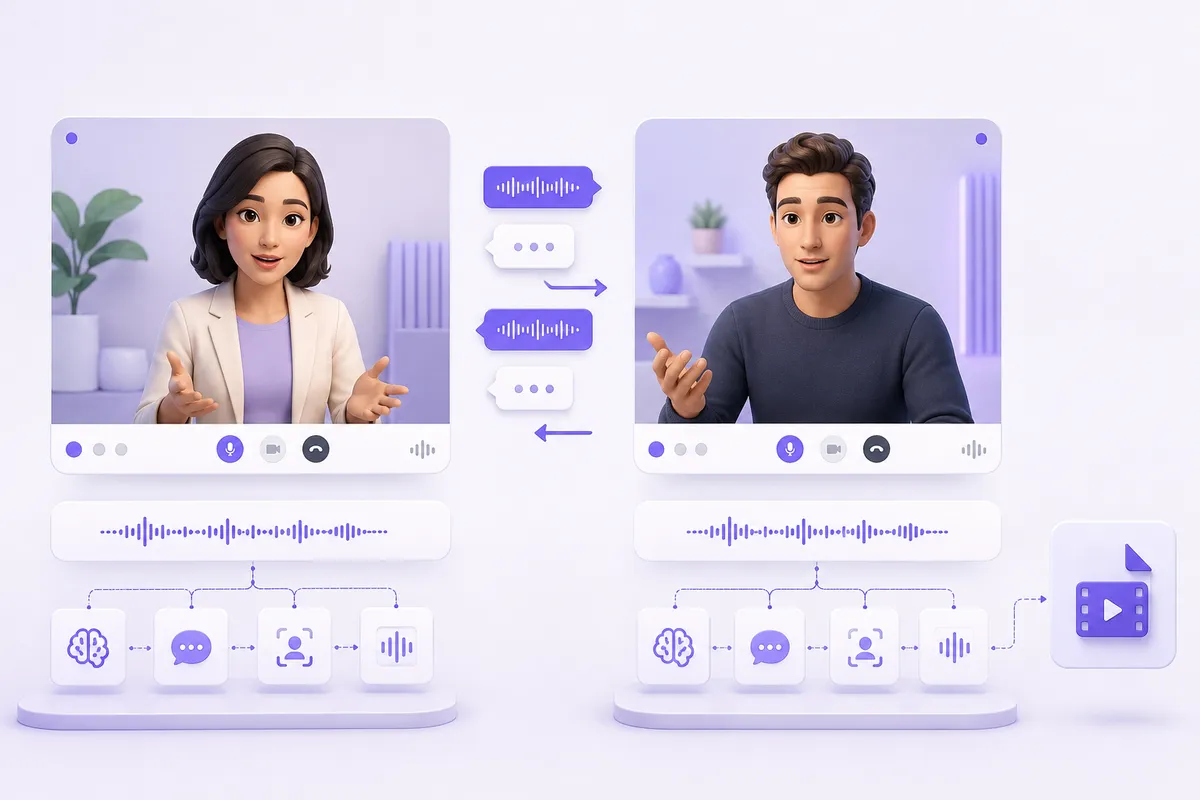
Tavus vs D-ID for conversational video
Decision question
Which product better fits a developer building a visual conversation: Tavus or D-ID? Choose Tavus when the team wants Tavus’s managed Conversational Video Interface (CVI), which documents a two-way WebRTC session with a room and meeting URL, plus configuration around the conversational experience. Choose D-ID when the team wants a documented WebRTC Realtime Agents route while also keeping a separate generated-video API workflow available within the same vendor. Both decisions require application work, policy ownership, and realistic conversation testing. Neither is an appropriate shortcut for a prerecorded campaign video, and neither vendor’s asynchronous generation path should be described as a real-time conversation.
This is a decision about the session, not the avatar still image. In a conversational product, the visitor connects, speaks, interrupts, waits for an answer, and may need help when the network or knowledge system fails. A rendered MP4 follows a different path: submit content, wait for processing, retrieve the file, and review it. Tavus documents CVI as live and MP4 generation as asynchronous. D-ID’s Quickstart distinguishes WebRTC Agent sessions from generated-video APIs. Preserve that distinction in requirements, architecture, budgets, and acceptance tests.
Side-by-side facts that matter
| Buyer concern | Tavus | D-ID |
|---|---|---|
| Documented interactive path | CVI is a managed, two-way WebRTC video session. Tavus creates a room and provides a meeting URL. | Realtime Agents use a documented WebRTC Agent-session path. |
| Conversation configuration | Documentation describes a persona layer (PAL), faces, greetings, language, captions, recordings, authenticated rooms, and duration controls. | The reviewed Quickstart establishes the Agent session; product teams must validate the specific agent, knowledge, and UI configuration they need. |
| Separate generated media | MP4 generation is documented as asynchronous. | Generated-video APIs are a separate request-and-result workflow. |
| Commercial starting point | Public plans list minutes and concurrency; the reviewed material does not publish a numeric latency SLA. | API pricing offers a Start Free Trial; specific paid streaming allowances must be confirmed directly. |
These statements are boundaries, not performance guarantees. WebRTC does not prove a particular end-to-end response time; it only establishes the type of session. Total user-perceived delay includes microphone capture, speech recognition, model retrieval and reasoning, text-to-speech, video delivery, client rendering, and network conditions. Measure it with the exact agent stack, geography, devices, and knowledge source that will go live.
Meaningful differences
Tavus is oriented around an integrated managed conversation surface. Its CVI documentation describes Tavus provisioning the room and meeting URL, with the team able to use the supplied interface or build its own. A face paired with a PAL provides a concrete place to configure behavior and context. That can reduce the amount of session plumbing a product team must assemble, while leaving the team responsible for the actual experience: authentication, disclosures, knowledge boundaries, tools, moderation, monitoring, and human escalation.
D-ID is a useful choice when engineering wants to reason explicitly about two products under one vendor: generated media and a WebRTC agent session. That separation is healthy for system design. A campaign-video service can have template validation, review, asset storage, and publication controls; a conversational service needs session creation, reconnect logic, user authorization, real-time telemetry, and recovery scripts. The fact that both can show an avatar should not lead a team to reuse the wrong test plan or budget assumption.
Both products remain developer-led investments. Neither official source set proves that a ready-made agent will answer correctly, meet a regulated obligation, recognize every interruption, or transfer an account-specific question safely. Buyers should consider visual quality one measurement among many, alongside task completion, factual accuracy, time to handoff, accessibility, consent, privacy, and operational recovery.
Choose Tavus when
Choose Tavus when a managed CVI flow is the clearest starting point and the team wants a documented room-based WebRTC experience with a configurable conversational layer. It is particularly appropriate for a tightly scoped visitor interaction such as guided qualification, a practice scenario, or a product explanation with a small approved knowledge base. Use the supplied meeting experience for an early usability test only if it matches the intended launch surface; then decide whether a custom interface is needed.
A Tavus proof of concept should include authenticated and unauthenticated scenarios as appropriate, a fixed maximum duration, a greeting, captions if relevant, and a tested handoff. Run a set of valid questions, out-of-scope questions, ambiguous questions, and requests for a person. Record connection setup, first response, barge-in behavior, reconnects, and what the visitor sees when an upstream service fails. Public minute and concurrency information can frame capacity discussions, but it is not a substitute for a full usage forecast.
Choose D-ID when
Choose D-ID when the product team wants an API-oriented visual-agent route with a documented WebRTC session, and may separately need reviewed generated videos. The split suits teams that can maintain separate lifecycle controls: asynchronous assets should be submitted, monitored, retrieved, and approved; live sessions should be authenticated, instrumented, and resilient to failure. Use the Start Free Trial only as an evaluation entry point; validate current access, metering, production limits, and streaming terms before assuming a long-term price.
In a D-ID evaluation, create a minimal browser experience around one narrow customer task. Confirm how an agent session is initiated and closed, what credentials remain server-side, and how the user is informed that it is interacting with automation. Test an incorrect answer, a request for account data, microphone denial, changing networks, an interrupted answer, and a human takeover. The video path should get its own script-review test rather than being measured through the same interactive demonstration.
When neither fits
Neither product is a default for a team that only needs a reviewed presenter video. A conventional avatar-video workflow is often simpler, safer, and easier to approve for that job. Neither is ideal when the organization cannot operate a knowledge source, review conversation logs responsibly, support a human handoff, or obtain clear rights for a custom likeness. And neither should be selected for production broadcasting, multistream relay, or physical-studio switching; those are different infrastructure problems.
Implementation and evaluation checklist
- Write one bounded user task and identify its owner, knowledge source, prohibited answers, and handoff destination.
- Separate live session telemetry from asynchronous media-generation metrics.
- Measure connection setup, first audible response, interruption recovery, reconnect behavior, and task completion on target networks.
- Keep credentials off the client where vendor guidance requires it; validate authentication and room access.
- Obtain consent, approved usage contexts, retention rules, and retirement steps for any custom face or voice.
- Confirm current plan, minutes, concurrency, streaming access, and production support before forecasting cost.
Official sources reviewed
- Tavus pricing — reviewed September 5, 2026.
- Tavus CVI conversation overview — reviewed September 5, 2026.
- D-ID API pricing — reviewed September 5, 2026.
- D-ID Quickstart — reviewed September 5, 2026.