 AI Live Video
AI Video Agents
Simli
A composable face-rendering option for teams that already understand their voice, model, and session architecture.
Best for: Engineers adding a visual avatar layer to an existing voice or multimodal agent
View detailsAI Video Agents
Tavus provides a conversational-video interface for building real-time, two-way calls with AI faces and configurable behavior.
Visit official website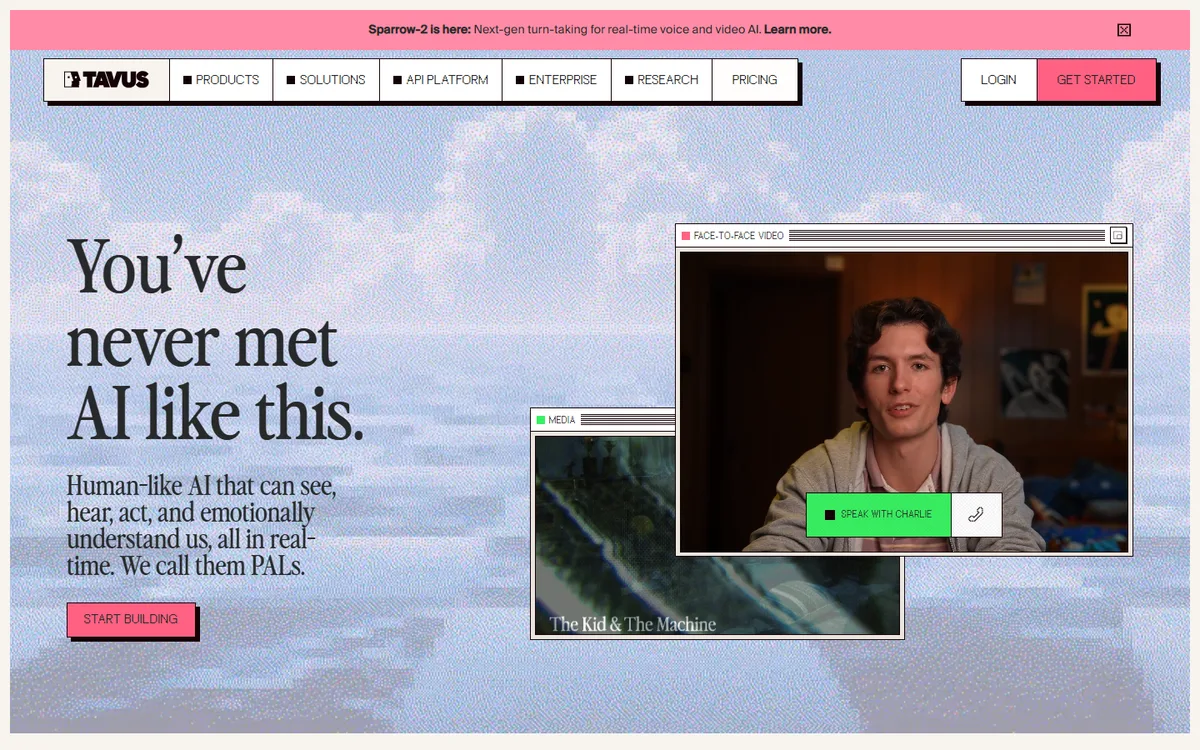
A developer platform for managed WebRTC video conversations when live sessions, not rendered clips, are the core product.
Best for: Product teams needing a configurable AI face in a live web or meeting experience
Tavus is a live-conversation product rather than a video-rendering service. Its Conversational Video Interface creates a two-way session between a visitor and an AI face using managed WebRTC. Documentation says Tavus creates the room, supplies a meeting URL, and lets a team use the supplied interface or build its own. That is different from ordering an MP4, waiting for processing, and publishing an asset. Tavus also offers video generation, but describes that separately as asynchronous. Real time is therefore native only for CVI.
A Tavus face is paired with a PAL that controls behavior and context. Current documentation calls out stock or custom faces, greetings, language, captions, recordings, authenticated rooms, and call-duration controls. This is enough for a useful prototype, but it does not make an agent safe or accurate by default. The application owner chooses the knowledge boundary, writes instructions, connects tools, discloses automation, and defines when a person takes over.
The pricing page makes the operating model concrete. The free developer plan lists 25 minutes of AI conversation, stock AI humans, and API access. Paid plans add minutes, custom faces, transcripts, and higher concurrency. It says billing measures live CVI use from connection to disconnect and that a created conversation can begin counting while the face waits in a room. Exercise abandoned joins, timeouts, and cleanup; a successful call alone will not reveal session cost.
The plan table names language-model processing, audio, WebRTC, perception, conversation flow, and Phoenix rendering. A smooth face is not a complete responsiveness measure. Public pages use quality and low-latency language but do not state a general numeric latency SLA. Measure setup, end-of-speech to first audio, end-of-speech to visible motion, interruption handling, and reconnect recovery with the selected model, browser, network, and knowledge source.
Keep credentials and room tokens server-side. Test expired, reused, and wrongly issued tokens. Decide whether recordings are necessary before enabling them; documentation says they can be stored in the customer’s S3 bucket, placing retention and deletion duties with the implementer. A custom face requires documented permission, permitted contexts, a removal owner, and clear disclosure. A knowledge base needs a refresh owner and tests for missing facts, adversarial requests, and handoff.
Choose Tavus when a team wants an integrated live-video pipeline and will own policy, measurement, and application design. Simli is closer for a face layer within a customer-owned voice stack. Anam is useful for a configurable four-stage pipeline. Soul Machines and UneeQ fit packaged agent or training buyers. Compare candidates with the same scenario, recovery cases, cost model, and disclosure rules.
For procurement, assign a named owner to the room lifecycle, source updates, consent record, and incident response. Run an acceptance test with a disconnected visitor, a stale answer source, an interrupted question, and a handoff request. That test reveals whether a managed video call is also an operationally supportable service.
Document the user-facing fallback message before rollout. It should explain the next step without exposing internal model errors, and provide a reliable person or non-video channel when live video cannot be established.
Native: Tavus documents CVI as a two-way real-time WebRTC video session and MP4 generation as asynchronous.
Last verified:
AI Video Agents
A composable face-rendering option for teams that already understand their voice, model, and session architecture.
Best for: Engineers adding a visual avatar layer to an existing voice or multimodal agent
View detailsAI Video Agents
A well-specified real-time avatar API for teams wanting a turnkey conversation path with optional bring-your-own components.
Best for: Teams embedding a configurable live avatar in a website or training experience
View detailsAI Video Agents
A packaged digital-person platform with interactive-minute plans and developer APIs for teams valuing agent design and workflow integration.
Best for: Organizations building interactive assistants with configurable behavior, reporting, and live deployment
View detailsAI Video Agents
A focused option for immersive AI role-play where coaching and credible practice matter as much as the avatar.
Best for: Organizations running sales, service, leadership, or education role-play with an interactive digital human
View details