 AI Live Video
AI Video Agents
Tavus
A developer platform for managed WebRTC video conversations when live sessions, not rendered clips, are the core product.
Best for: Product teams needing a configurable AI face in a live web or meeting experience
View detailsAI Video Agents
UneeQ, now presented through Digital Humans, provides digital-human technology and immersive training for live AI role-play.
Visit official website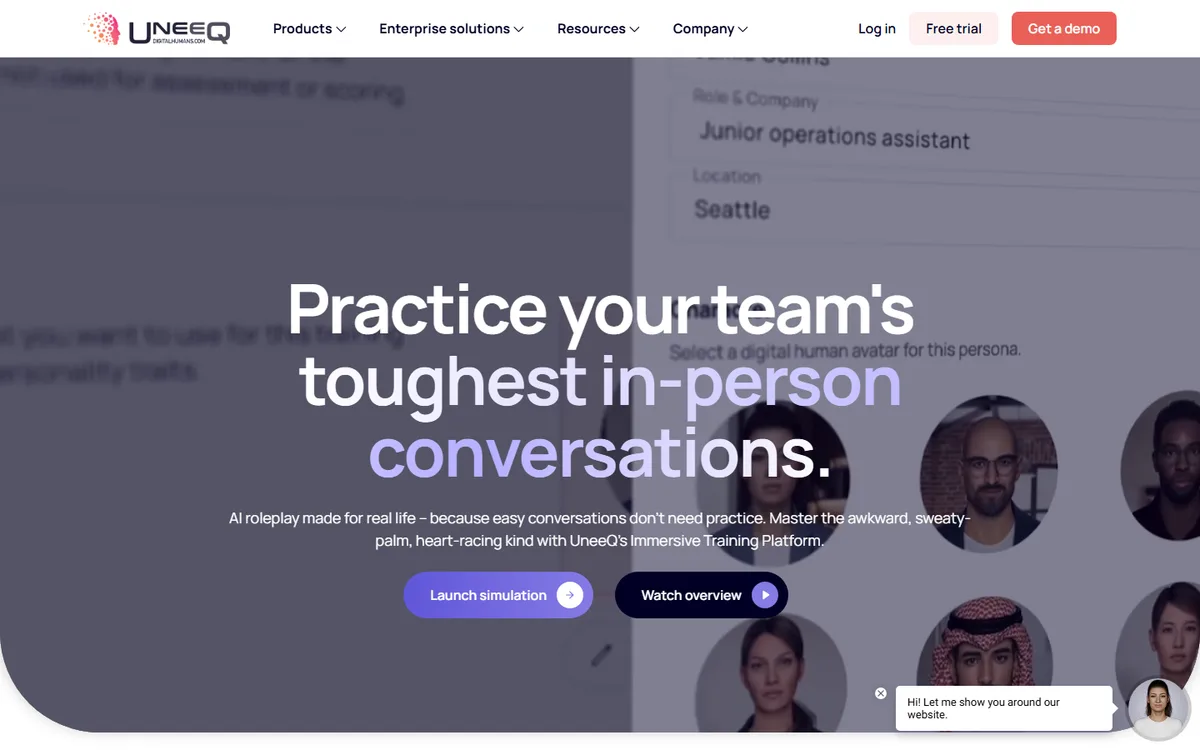
A focused option for immersive AI role-play where coaching and credible practice matter as much as the avatar.
Best for: Organizations running sales, service, leadership, or education role-play with an interactive digital human
UneeQ’s former domain redirects to Digital Humans, where the company presents its Digital Human OS and Immersive Training Platform. The emphasis is not merely placing a talking face on a page. It is letting learners rehearse difficult conversations with a digital human that listens, responds, challenges, and produces coaching. Sales discovery, customer-service de-escalation, leadership conversations, and education are named examples. The right evaluation question is whether the experience creates credible practice and useful feedback, not whether an avatar looks realistic in isolation.
Digital Human OS is described as a stack involving behavior and animation, LLM orchestration, streaming, speech recognition, text-to-speech, integrations, SDKs, and API calls. Feature pages say digital humans can deploy in browsers, kiosks, mobile applications, cloud, on-premise, or hybrid environments, and connect through SDKs or REST APIs. This supports API availability, but does not promise that a particular integration is in a trial. Treat deployment as engineering and commercial discovery.
UneeQ says its OS achieves sub-one-second response times and describes interactive digital-human experiences. That supports native real time because the stated product is live interaction rather than an offline render queue. It does not support a general SLA claim. The published statement does not define measurement boundary, model, network, device, workload, or availability term. Measure end-of-speech to acknowledgement, meaningful spoken content, animation continuity, interruption response, and reconnection in the intended environment.
Visual behavior has its own scorecard. The OS page describes Synanim as a real-time behavior engine for expressions and emotions, while integration material discusses deployment and business data. These features can make a scenario credible, but cannot prove the LLM uses correct information or that an action is authorized. In training, score simulations against a scenario rubric and use subject-matter experts to review whether feedback reflects learner choices. In customer service, test refusal, handoff, minimization, and disclosure before engagement.
The training trial page offers 30 days, no credit card, and instant access for new users. It says users choose a pre-built scenario, complete a role-play, and receive personalized coaching. That is confirmed only for Immersive Training, not a published free allowance for every OS deployment. Public feature pages instead invite organizations to discuss integration requirements. Set custom public-avatar, kiosk, and enterprise pricing to contact sales until a proposal defines usage.
Run representative learners through the same scenario repeatedly. Check feedback consistency, appropriate pushback, explanation of scoring, accessibility, microphone behavior, browser support, and retention. Decide who can alter scenarios, prompts, or knowledge. For a branded digital human, put likeness approval, brand review, and a takedown route into launch control.
Choose UneeQ when the outcome is immersive practice or a tailored enterprise digital-human experience. Soul Machines is the closest packaged-agent comparison. Tavus and Anam suit developer-led live-avatar builds, while Simli is appropriate for a customer-owned agent stack. Select after measuring learning or task outcomes, not visual polish or an unqualified timing statement.
For a public experience, specify what happens after an uncertain answer, a vulnerable disclosure, or a technical failure. Review scenario performance across different accents and devices. These conditions determine whether the role-play remains constructive when it leaves the carefully prepared demonstration environment.
Native: UneeQ describes interactive experiences and sub-one-second response times, but the public claim is not a latency SLA.
Last verified:
AI Video Agents
A developer platform for managed WebRTC video conversations when live sessions, not rendered clips, are the core product.
Best for: Product teams needing a configurable AI face in a live web or meeting experience
View detailsAI Video Agents
A composable face-rendering option for teams that already understand their voice, model, and session architecture.
Best for: Engineers adding a visual avatar layer to an existing voice or multimodal agent
View detailsAI Video Agents
A well-specified real-time avatar API for teams wanting a turnkey conversation path with optional bring-your-own components.
Best for: Teams embedding a configurable live avatar in a website or training experience
View detailsAI Video Agents
A packaged digital-person platform with interactive-minute plans and developer APIs for teams valuing agent design and workflow integration.
Best for: Organizations building interactive assistants with configurable behavior, reporting, and live deployment
View details