 AI Live Video
AI Video Agents
Tavus
A developer platform for managed WebRTC video conversations when live sessions, not rendered clips, are the core product.
Best for: Product teams needing a configurable AI face in a live web or meeting experience
View detailsAI Video Agents
Simli is a developer-focused speech-to-video API for adding real-time, lip-synced avatar faces to conversational applications.
Visit official website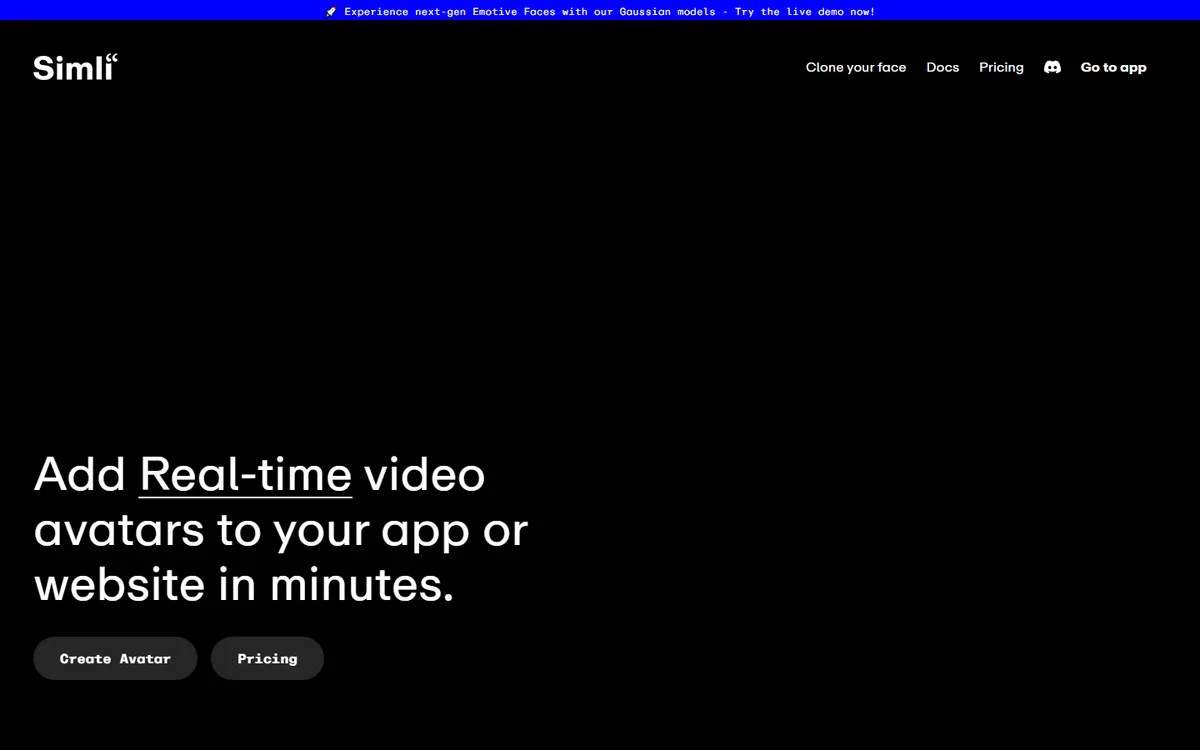
A composable face-rendering option for teams that already understand their voice, model, and session architecture.
Best for: Engineers adding a visual avatar layer to an existing voice or multimodal agent
Simli handles the visual part of an AI conversation: it turns speech into a lip-synced avatar stream for a website or product. Its documentation describes an API for adding faces to real-time agents and construction paths through LiveKit, Pipecat, and Simli SDKs. A buyer should not mistake that for a claim that Simli supplies policy, retrieval, language-model selection, or voice design. It can be the face in a larger system whose remaining components are customer-owned.
The company publishes a useful latency qualification. Its homepage presents a speech-to-video estimate below 300 milliseconds beside separate estimated ranges for speech recognition, language models, and text-to-speech. The same page says those calculations are estimates and may not reflect actual agent latency. This helps isolate rendering delay, but it is not an end-to-end SLA. Measure the path from a final user audio frame through transcription, reasoning, synthesis, rendering, and delivery on real browsers and networks.
For teams with established voice agents, the SDK or communication-platform path may be cleanest. Keep the existing retrieval, tool calling, and logging, then introduce the avatar stream as one component. Test whether interruption stops speech and face motion promptly, whether reconnect preserves state, and how the interface behaves in audio-only conditions. Composability reduces migration work but requires an owner for each upstream service and credential.
Simli Auto is the more managed route. Documentation describes session tokens, a configurable endpoint for an end-to-end session, optional TTS keys, transcript retrieval, and custom OpenAI-compatible model configuration. It also says Simli Auto development has ceased for now and directs teams needing more composability to the main API. That does not make Auto unusable, but it is a lifecycle question before making it central to a long-lived product.
The homepage advertises $10 on signup and a monthly top-up of 50 minutes on its free plan, with volume discounts and pay-as-you-go plans. Terms describe video-stream usage minutes and trial credits. Confirm allocation, billing clock, region, and quota behavior in a test account. External ASR, LLM, TTS, hosting, and observability costs may remain separate.
Track active streams, idle sessions, generation attempts, and model calls separately. Exercise a slow reply, microphone denial, packet loss, device rotation, and abusive input. The face should not conceal unavailable source data or an unbounded request. For a realistic likeness, collect permission and tell visitors that they are interacting with software.
Choose Simli when a fast visual response layer must plug into an architecture you control. Tavus is stronger for an integrated managed room. Anam offers turnkey and bring-your-own pipeline choices. Soul Machines and UneeQ target packaged digital-person programs. Evaluate Simli with actual upstream services, because a face-only demo cannot establish answer quality, privacy posture, or total latency.
Before committing to a composed architecture, map where transcript data, audio, video frames, and account identifiers travel. Make a support matrix for each provider, including rate limits and outage behavior. The evaluation succeeds only when the visual stream, voice loop, and business logic fail safely together.
A production checklist should name the owner for this review.
Native for speech-to-video streams; Simli's <300 ms figure is a rendering estimate, not conversational SLA.
Last verified:
AI Video Agents
A developer platform for managed WebRTC video conversations when live sessions, not rendered clips, are the core product.
Best for: Product teams needing a configurable AI face in a live web or meeting experience
View detailsAI Video Agents
A well-specified real-time avatar API for teams wanting a turnkey conversation path with optional bring-your-own components.
Best for: Teams embedding a configurable live avatar in a website or training experience
View detailsAI Video Agents
A packaged digital-person platform with interactive-minute plans and developer APIs for teams valuing agent design and workflow integration.
Best for: Organizations building interactive assistants with configurable behavior, reporting, and live deployment
View detailsAI Video Agents
A focused option for immersive AI role-play where coaching and credible practice matter as much as the avatar.
Best for: Organizations running sales, service, leadership, or education role-play with an interactive digital human
View details