 AI Live Video
AI Avatars & Digital Humans
Synthesia
A fit for planned branded presenter videos when the work is production rather than a native live-avatar session.
Best for: Learning and communications teams producing repeatable scripted video
View detailsAI Avatars & Digital Humans · AI Video Agents
HeyGen is an avatar-video platform with a separate LiveAvatar offering for streamed interactive avatar experiences.
Visit official website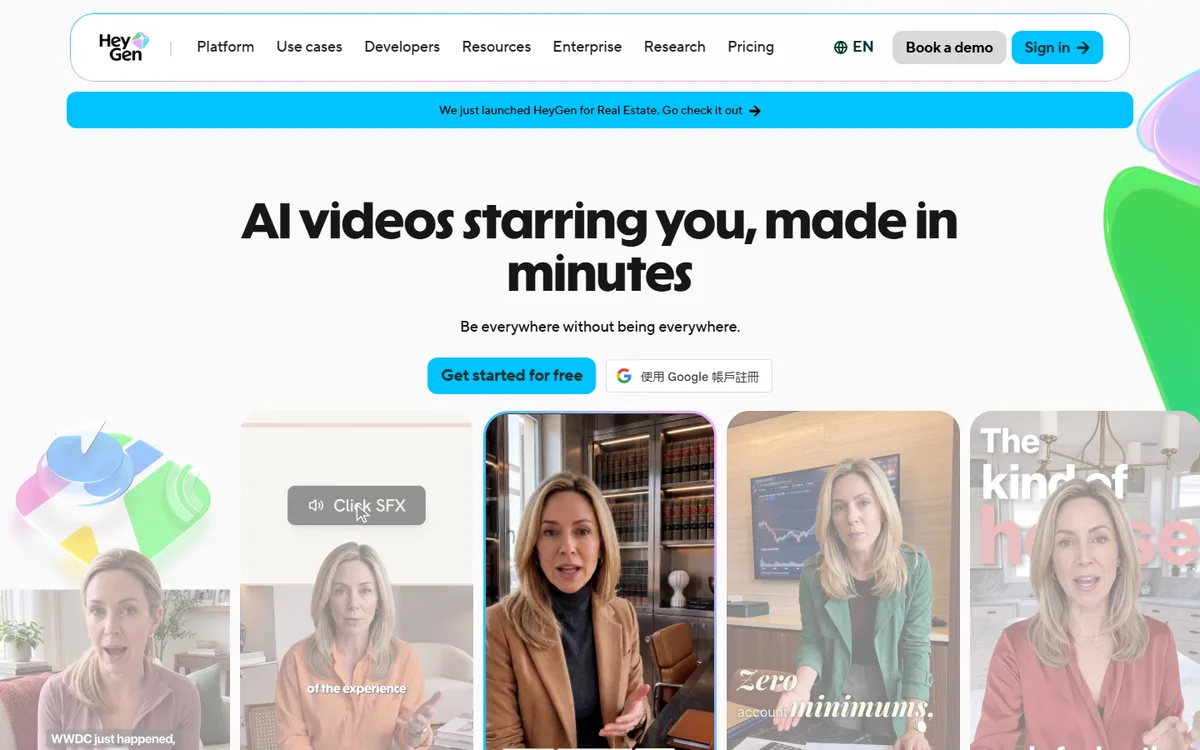
A practical choice when a team needs scripted avatar video and a separately priced streaming-avatar path.
Best for: Teams pairing pre-produced avatar clips with an interactive web experience
HeyGen has two distinct shapes that should be evaluated separately. Its familiar studio produces scripted avatar videos, including translated and localized material. LiveAvatar is a separate product for streamed, interactive experiences. The official LiveAvatar announcement discusses session limits, concurrency, and streaming credits, so this record marks real time as native only for that offering. A standard studio render is still a production job: it is prepared, submitted, processed, and reviewed before publication.
That distinction makes HeyGen useful for a team with both communication and product needs. A learning group can make a repeatable onboarding video from an approved script, while a product team can investigate a web-based LiveAvatar experience. It does not mean one subscription automatically covers both jobs. The main pricing page publishes a Free tier, Creator, Pro, Business, and Enterprise options; the developer documentation and LiveAvatar material should be checked separately for the exact API or streaming entitlement.
The public pricing page gives a concrete starting point for a studio pilot. The free plan lists three videos a month, videos up to one minute, standard processing, access to Avatar IV, and more than 500 stock video avatars. Paid plans add credits, longer maximum video length, higher export resolutions, photo avatars, and broader language access. Those details suggest a sensible test: create the same short product explanation in a stock-avatar version, a custom-avatar version if authorized, and one target-language version. Review the pronunciation of product names, on-screen layout, captions, and whether the translated script retains the intended meaning.
HeyGen’s team-oriented features also matter when video is a publishing workflow rather than a one-person experiment. The Business plan lists workspace collaboration, draft comments, central billing, role-oriented controls, interactive-video features, SCORM export, and LMS integrations. A buyer should validate which of those features are actually included in the selected billing arrangement. In particular, a monthly credit model makes usage depend on model choice, duration, and generation complexity, rather than simply on the count of finished videos.
For LiveAvatar, start with a small interaction that has a bounded knowledge source and an explicit handoff. Measure session setup, first response, barge-in behavior, microphone permission failures, reconnects, and concurrent sessions on the network where users will work. A visually fluent response is not evidence that the retrieved answer is current or correct. The application owner still needs authentication, input handling, an approved knowledge source, moderation rules, logging, and a path to a person.
HeyGen’s main site also advertises video translation and custom avatar options, but these need separate governance. Get documented permission for a person’s likeness or voice before creating a custom asset. Keep the original consent record, define who may reuse the asset, and establish removal and retention procedures. For localization, have a qualified reviewer check names, dates, regulated statements, and cultural references instead of treating lip synchronization as a quality sign-off.
Choose HeyGen when the organization values a polished studio workflow now and wants the option to test a separately priced interactive avatar later. Budget studio creation and LiveAvatar sessions independently; do not infer a live-service latency guarantee from video-processing language. Synthesia and DeepBrain AI are closer comparisons for governed scripted video. D-ID and AKOOL are stronger comparisons when the immediate question is how an engineering team will integrate a real-time visual agent. A good buying decision comes from a representative script and a measured live proof of concept, not from mixing the two product categories in one demo.
Native for the separately priced LiveAvatar product; ordinary avatar-video renders are a production workflow, not a live call.
Last verified:
AI Avatars & Digital Humans
A fit for planned branded presenter videos when the work is production rather than a native live-avatar session.
Best for: Learning and communications teams producing repeatable scripted video
View detailsAI Avatars & Digital Humans
An API-first option for teams that need generated avatar video and documented WebRTC real-time agent sessions.
Best for: Engineering teams building a visual agent with custom knowledge and web delivery
View detailsAI Avatars & Digital Humans
A developer-oriented streaming-avatar option for teams prepared to run WebRTC sessions and secure backend APIs.
Best for: Product teams building a browser-based conversational avatar with owned session infrastructure
View detailsAI Avatars & Digital Humans
A candidate for scripted avatar production with conversational options that need separate entitlement and latency verification.
Best for: Teams creating scripted training, marketing, and internal presenter videos
View details