Editorial notes
Interprefy at a glance
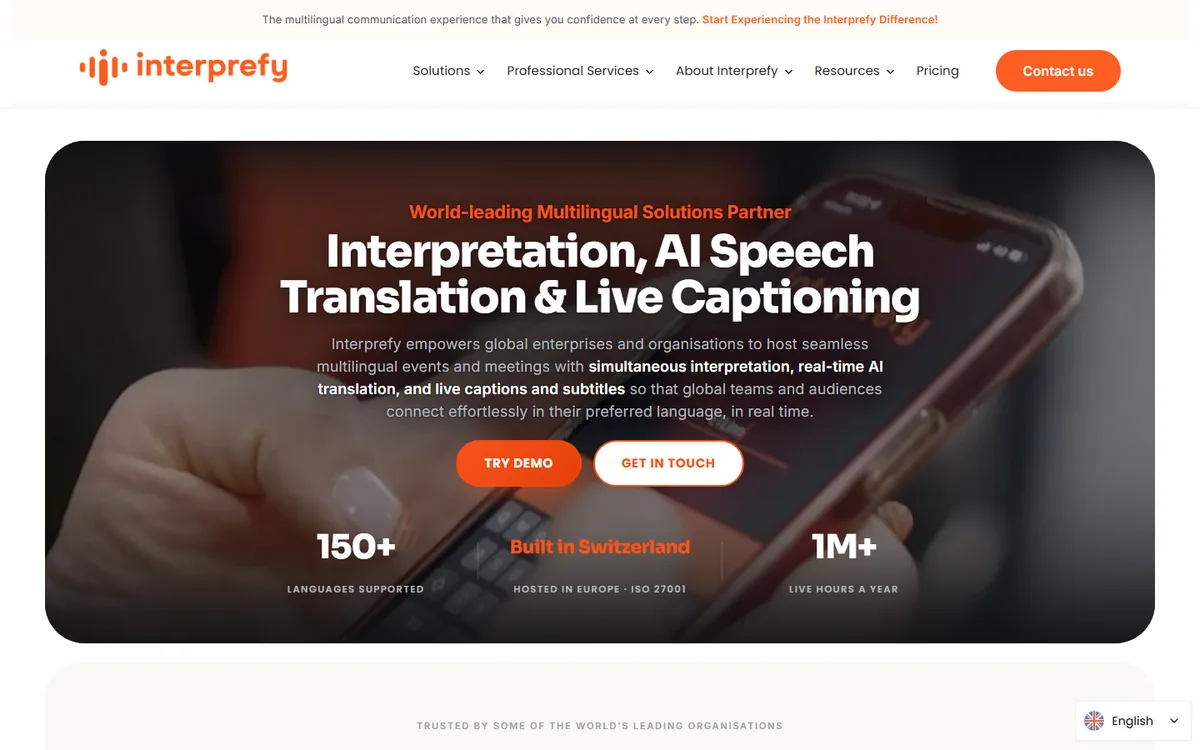
Interprefy is a multilingual communication provider for events, meetings, broadcasts, and webinars. Its essential distinction is that it offers more than one language-access mode. The official site separates remote simultaneous interpretation by professional interpreters from AI speech translation and from live captions and subtitles. A program can therefore decide whether a session needs a human interpreter, machine-generated translated speech, text on screen, or a combination. That is more useful than treating every translated word as equivalent.
The homepage says AI speech translation is real-time and describes it also as AI voice translation. It separately describes multilingual live captions and subtitles, and says it supports more than 80 meeting and event platforms plus on-site and broadcast AV. Named integrations include Teams, Zoom, Webex, ON24, Cvent, Adobe Connect, and Google Meet. Those names establish integration intent, not an automatic compatibility guarantee for a particular account, event plan, or encoder. Confirm the exact path before production.
The live language boundary
For this directory, Interprefy is native live translation because relevant outputs are designed for an ongoing session. A speaker’s audio is interpreted by a professional or translated by AI while participants attend, and the audience can receive spoken interpretation or AI speech translation, live captions, and subtitles. Interprefy says it can add real-time interpretation and captions to live broadcasts. This is not merely later translation of a recording.
Important boundaries remain. Captions and subtitles are text; they do not establish translated audio. AI speech translation is translated or interpreted audio, but reviewed pages do not say it creates a permanent dubbed replacement for a finished program. The site’s Media Hub material covers recordings, transcripts, summaries, and raw or professionally edited content, which is a media workflow rather than evidence of real-time dubbing. Do not describe the caption service as dubbing, or promise every integration returns a dubbed program feed without a specific delivery design.
Interprefy makes a useful human-versus-AI distinction. Its site positions professional interpreters where nuance is decisive and AI speech translation where scale is needed. That is product guidance, not a blanket quality ranking. Legal, medical, investor, diplomatic, or safety-critical content needs an explicit risk decision, terminology preparation, sound checks, and a human-language plan where needed. A short prepared presentation may choose AI for coverage, whereas a tense negotiation may require professional interpreting or a scoped caption-only route.
Planning, price, and limits
Interprefy’s pricing page says pricing is tailored to event size and requirements and highlights remote interpretation, live captions, and AI speech translation as configurable solutions. It does not publish a numeric rate card or durable free tier in reviewed pages. Consequently its pricing is custom and free access is unknown. Public material reviewed does not establish a developer API, so API availability is unknown; a platform integration should be checked rather than inferred.
Identify source and audience languages, devices, and whether listeners need translated audio or can use text. Include the meeting platform, AV and broadcast route, accessible caption presentation, and a fallback for noisy or disconnected source audio. Rehearse speaker changes, terminology, named entities, music, crosstalk, and an AI-to-human switch. Choose Interprefy when a managed enterprise design can place human interpretation and AI speech translation in the same event plan. It is not shorthand for post-production dubbing; select and evaluate its live and media services separately.
 AI Live Video